



Summary:Polymers play a vast number of roles in daily life, but they lack many properties that would make them even more useful. As in cooking, a way around these limitations is to mix in other ingredients that have the right properties. Scientists have just made recipe development a more palatable job.
Imagine you’re baking a special cake, one in which the shape of each mote of spice mixed into the batter can have a profound effect on your dessert’s color, its taste, its texture on the tongue. That’s a rough description of creating new lightweight materials for aircraft, cars and windmills that use tiny nanoparticles as ingredients, and scientists at the National Institute of Standards and Technology (NIST) have made recipe development a more palatable job.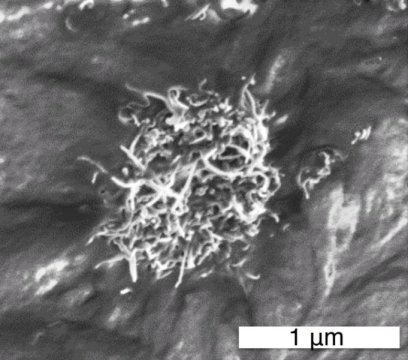
Polymers–a large class of materials that includes plastics–play a vast number of roles in daily life, but they lack many properties that would make them even more useful. As in cooking, a way around these limitations is to mix in other ingredients that have the right properties. Polymers conduct electricity poorly, for example, but adding carbon nanotubes (CNTs) or graphene sheets forms a strong, lightweight “nanocomposite” whose electrical conductivity can be more than a million times higher.
But the variety of options can confound designers. If they can find the right combination of polymer and particles, manufacturers can mix up a nanocomposite that has just the right properties for a job–be it strength, flexibility, conductivity, or a host of others. But with so many polymers and nanoparticles to choose from, devising the best recipe is often a matter of trial and error. That’s largely because there has been no way to predict the resulting mix’s capabilities based on what each ingredient can do. Why not? In a word, math.
The effect the added particles have on the polymer is profoundly influenced by their shape. But it’s hard to account for the complex shapes of the particles mathematically; in fact, it’s a famously difficult math problem. So it’s tough to create models that account for this essential design variable. Materials designers have been forced to model their mixtures using the assumption that all particles were shaped like spheres–an unrealistic picture, to say the least.
“It’s been called the ‘spherical cow’ approach,” says NIST materials scientist Jack Douglas. “It isn’t too helpful when your particle is shaped like a bush or a dust-bunny or crumpled paper, which are what nanoparticles can look like in a mixture. CNTs, for example, aren’t the idealized tubes you often see in magazines; their complicated shape depends sensitively on the exact conditions under which the particles are made.”
The team dealt with this issue by exploiting a kernel idea from a seven-decade-old math paper by Shizuo Kakutani, who suggested a way of more realistically modeling particle shapes in material property calculations. Using his ideas for practical materials science would have required far more number-crunching power than was available in Kakutani’s day, but modern computers make this class of problems easier to handle. The team first created virtual nanoparticles that have the same physical shape as the real-world particles they want to analyze, and they then calculated the relevant properties using a publicly available software package (ZENO) developed partly at NIST.
“We generate thousands of examples of the shapes we want, enough to represent variation in the real world,” says Douglas. “That gives us enough information to make general statements about their behavior in the mix.”
Since polymer nanocomposites are central to many developing technologies relating to the energy, auto and airline industries, Douglas says, this theoretical effort promises to have an appreciable impact. The team’s paper focuses on mixing CNTs or graphene with polymers, but the math has wider application.
“We can use it in any problem in which objects of complex shape arise,” he says. “For example, we are currently applying it to classify the shapes of stem cells as well as to biometric data.”
Source:National Institute of Standards and Technology
(http://www.sciencedaily.com/releases/2015/12/151222163448.htm)