


Indian Bureaucracy News, New Delhi, February 27, 2026
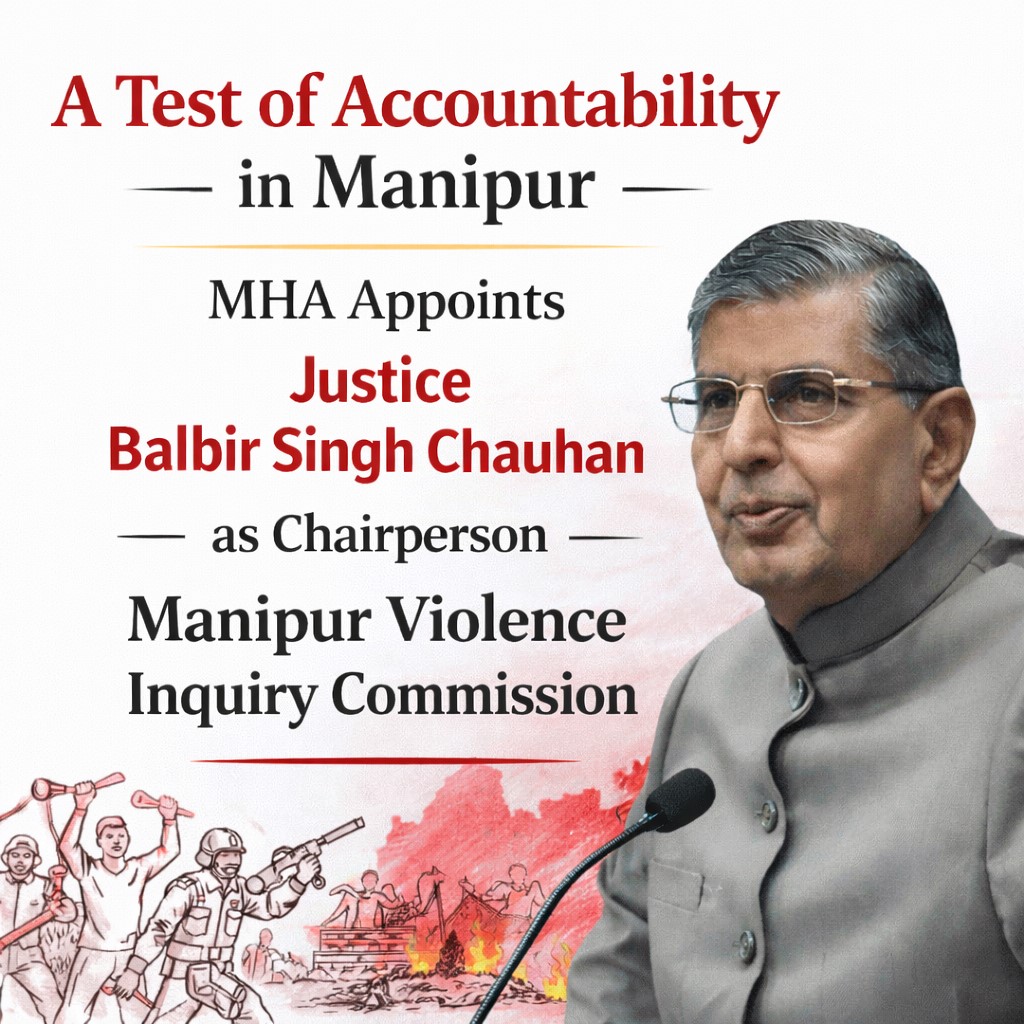
A Test of Accountability in Manipur, Justice Balbir Singh Chauhan Appointed Chairperson of Manipur Violence Inquiry Commission
The Union government’s decision to appoint Justice Balbir Singh Chauhan, former judge of the Supreme Court of India, as Chairperson of the Commission of Inquiry into the Manipur violence comes at a fraught moment. Nearly three years after ethnic clashes first engulfed the State, the search for truth and accountability remains halting and incomplete. Justice Chauhan will assume charge on March 1, 2026, following the resignation of Justice Ajai Lamba, former Chief Justice of the Gauhati High Court, who stepped down as Chairperson with effect from February 28, 2026.
Justice Balbir Singh Chauhan (born July 2, 1949, Meerut) is a former judge of the Supreme Court of India and ex-Chief Justice of the Orissa High Court. Elevated to the apex court in 2009, he later chaired the 21st Law Commission of India and now heads the Manipur Violence Inquiry Commission (2026).
The Commission was originally constituted through notification S.O. 2424 (E) dated June 4, 2023, issued by the Ministry of Home Affairs under the Commissions of Inquiry Act, 1952. Subsequent amendments in September 2023, December 2023, May 2025, and December 2025 have extended its functioning, though its Terms of Reference remain unchanged. Though the continuity of mandate stands in stark contrast to the scale of upheaval that unfolded in Manipur beginning May 3, 2023.
The Scale of the Tragedy
The ethnic conflict between Imphal Valley-based Meiteis and adjoining hills-based Kukis, which erupted on May 3, 2023, has left a trail of unprecedented devastation. Official data and reports paint a grim picture. More than 260 people have been killed since the violence began. Data from the National Crime Records Bureau records 24 civilian deaths due to extremist violence in 2023 — the highest in the country — along with six deaths during police lathi charge incidents linked to riots.
Nearly 67,000 to 70,000 people have been rendered homeless and displaced internally, marking the highest displacement triggered by conflict and violence in India since 2018. The destruction of property has been unprecedented. Manipur recorded over 6,200 cases of arson in 2023, compared to fewer than 30 annually in each of the preceding five years. The State accounted for roughly 45% of all arson cases registered nationwide that year. Churches, temples, homes and vehicles were set ablaze.
Equally alarming was the looting of more than 6,000 firearms from police armouries in the early days of unrest. Though over 3,000 weapons have reportedly been recovered, the continuing circulation of arms has complicated restoration of order. Violent crime figures surged dramatically, with 14,427 cases recorded in 2023 compared to 631 in 2022.
Sexual Violence and Institutional Failure
Perhaps the darkest chapter of the conflict has been the systematic use of sexual violence as a weapon against indigenous women and girls. The nation was jolted in July 2023 by a viral video showing two Kuki women being paraded naked and assaulted by a mob. While four people were eventually arrested in connection with that incident, justice has remained elusive for many survivors.
In a tragic reminder of this ongoing failure, a 20-year-old Kuki-Zo woman, who was gang-raped in May 2023 at the age of 18, died on January 10, 2026, due to prolonged illness linked to her injuries. Abducted from near an ATM booth in Imphal, she was taken to a hilltop, sexually brutalized, and dumped in a creek. Despite an FIR being filed and the case transferred to the CBI in July 2023, no arrests have been reported in that case. Her mother’s only wish remains “to see the people who did this to her punished.” Her death has intensified concerns about the pace of justice and institutional responsiveness.
Amnesty International India, responding to her death, stated that it “exposes systemic impunity for sexual violence in Manipur” and that survivors have been failed by a system that “neither acknowledged nor addressed” their trauma — an emblematic case of systemic impunity and institutional failure to adequately support survivors of sexual violence.
The Road Ahead
The Supreme Court had earlier come down heavily on the Manipur Police, describing the investigation process as “tardy” and “lethargic.” In August 2023, the Court observed that the “state police has obviously lost control of the situation” with “no law and order left,” pointing to a “complete breakdown of the machinery of the State.” The Court had directed the classification of over 6,500 FIRs to understand the true scale of offenses, including murder, rape, arson, and destruction of property.
As Justice Chauhan assumes charge, the Commission of Inquiry faces a formidable task. Under the Commissions of Inquiry Act, 1952, its mandate is to establish facts and recommend measures; it does not substitute for criminal prosecution. Yet its findings will shape public memory and institutional reform.
For Manipur, the issue is no longer confined to communal violence. It concerns the credibility of investigative institutions, the efficacy of administrative oversight, and the ability of the Indian State to ensure justice across regions marked by ethnic fault lines. Nearly three years on, the victims’ demand is not merely for documentation but for accountability. Whether this reconstituted Commission can meet that expectation will test both its independence and the resolve of the Union government.