


The Department of Administrative Reforms & Public Grievances (DARPG) conducted the 5th National e-Governance Webinar, featuring outstanding initiatives under themes like “Excellence in District Level Initiative in e-Governance for Other States” and “Excellence in Government Process Re-engineering for Digital Transformation at States and Union Territories.” The primary goal is to encourage the sharing of knowledge and replication of successful e-Governance projects across India. Additionally, in a distinct event during the recently concluded Launching of the Monograph on Innovations in Public Administration by the Capacity Building Commission (CBC) in New Delhi, the Union Minister of State (Independent Charge) Dr Jitendra Singh urged the Commission to actively publicise innovations in Public Administration.

The History of Gang Canal of Rajasthan
The Ganga Canal of Rajasthan, also known as Gang Canal, is an irrigation network established by Maharaja Ganga Singh in the early twentieth century in the present district of Sri Ganganagar, Rajasthan. Originating from the Sutlej River near Firozpur, Punjab, near the India–Pakistan border, it traverses the districts of Faridkot, Fazilka and Muktsar.
During the Indian famine of 1899–1900, Bikaner state faced severe repercussions. To address this issue permanently, the East India Company enlisted the services of A.W.E. Standley, chief engineer, in 1903 to find the feasibility of irrigating the western area of the Bikaner State from the Satluj Waters. The plan, designed by the then chief engineer of Punjab, Mr. R. G. Kennedy, proposed bringing the vast area of the erstwhile Bikaner state under irrigation through the Satluj Valley Project.
Delays ensued, however, with the intervention of the Viceroy of India, Lord Curzon, in 1906 and 14 years later on September 4, 1920 an agreement was signed . The foundation stone of Canal Head Works at Ferozepur was laid on December 5, 1925, and the project was completed and inaugurated by then Viceroy of India Lord Irwin in 1927. At that time it included 89 miles of constructed lined canal. The irrigated parts of the Bikaner State, now Sri Ganganagar district and Hanumangarh district, fell under the canal’s influence, irrigating 303,000 hectares of land, roughly equivalent to the Upper Bari Doab Canal. The project cost amounted to Rs. 310.97 Lakhs until 1943. Following the canal’s construction, people from south Punjab migrated to the area, prompting the state administration to provide various facilities for them. The availability of water transformed the region into fertile land, and Ganganagar became the granary of Rajasthan.
Present Day and Innovation

Prior to this intervention, the process of dissemination of such vital information like water supply timings, availability of water level at head of the canals was conveyed to the farmer community through the local newspapers after a 24-hour delay as the administration was largely depended on manual processes for collection of data from multiple local sites, resulting in angst in the community often leading to protests and demonstrations in the district.
The Gang Canal Regulation Computerization System covers a network of 23 canals, 1222 villages of 7 blocks of the district Ganganagar and benefits over 3 lakh farmers of the region. The automatic system made computerized regulation chart and ensured the amount of inflow of water in the district is available for everyone to see on real-time basis.

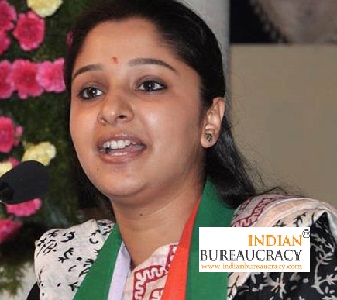
Smt Rukmani Riar Sihag, is currently serving as the Municipal Commissioner of Greater Jaipur, has received the prestigious National E-Governance Award in the gold category at the recently concluded National E-Governance Conference held in Jammu.
Indian Bureaucracy congratulates Smt Rukmani Riar Sihag and the Office of the District Collector, Sri Ganganagar District, Government of Rajasthan and wishes them the very best.