


As per 2011 census, there are 43.53 lakh main workers in the age group of 5-14 years in various occupation and process including domestic work in the country. As per Ministry of Labour & Employment, Government is following a multi-pronged strategy for elimination of child labour. It comprises of statutory and legislative measures, rehabilitation and universal elementary education along with convergence with other schemes for socio economic development. Government has enacted the Child Labour (Prohibition & Regulation) Amendment Act, 2016 which came into force w.e.f. 1.9.2016. The Amendment Act inter alia provides for complete prohibition of work or employment of children below 14 years in any occupation and process and adolescents in the age group of 14 to 18 years in hazardous occupations and processes. The amendment also provides stricter punishment for employers for violation of the Act and made the offence as cognizable.
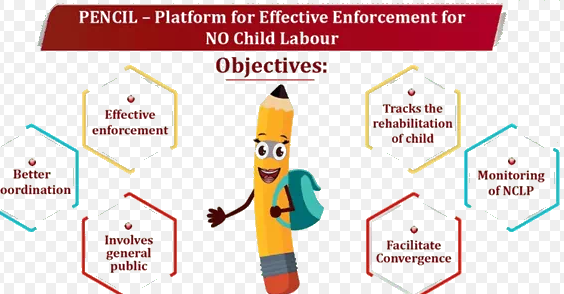
After strengthening the legislative framework through amendment in Child Labour Act, Government has framed the Child Labour (Prohibition & Regulation) Amendment Rules, 2017 which inter alia specifies the duties and responsibilities of State Governments and District Authorities to ensure effective enforcement of the provisions of the Act. Government has also devised a Standard Operating Procedure (SOP) as a ready reckoner for trainers, practitioners and enforcing and monitoring agencies. Government is also implementing the National Child Labour Project (NCLP) Scheme for rehabilitation of child labour. Under the Scheme children in the age group of 9-14 years, rescued/withdrawn from work are enrolled in the NCLP Special Training Centres, where they are provided with bridge education, vocational training, mid day meal, stipend, health care, etc. before being mainstreamed into formal education system. Further to ensure effective enforcement of the provisions of the Child Labour Act and smooth implementation of the NCLP Scheme a separate online portal PENCIL (Platform for Effective Enforcement for No Child Labour) has been developed.
In addition to above Ministry of Women and Child Development has enacted Juvenile Justice (Care and Protection of Children) Act, 2015 (JJ Act). As per Section 2 (14) (ii) and (ix) of JJ Act, a child who is found working in contravention of labour laws for the time being in force or is found begging, or living on the street and who is found vulnerable and is likely to be inducted into drug abuse or trafficking is included as a “child in need of care and protection”, among others. The children in need of care and protection (CNCP) for rehabilitation has been placed in institutional care i.e. Children Homes or non-institutional care, such as sponsorship, foster care by Child Welfare Committee. As per JJ Act, 2015, State/UTs are required to set-up Child Care Institutions (CCIs) and are also required to register and monitor them under Section 41 and 54 of the Act respectively. The primary responsibility of execution of the Act, lies with the State/UTs. However, Central Government is managing “Child Protection Services” (CPS) (erstwhile Integrated Child Protection Scheme) under umbrella Integrated Child Development Services, and providing financial assistance, as Grant-in-Aid, to the States/UTs on sharing pattern for, inter-alia, undertaking a situational analysis of children in difficult circumstances, for setting up and maintenance of various types of CCIs. Further National Commission for Protection of Child Rights (NCPCR), a statutory organization under this ministry, has developed a Standard Operating Procedure (SOP) for care and protection of Children in Street Situations to streamline the processes and interventions regarding children in street situations. Under the scheme “CPS”, institutional care is provided through CCIs, as a rehabilitative measure. In these CCIs, children are provided age appropriate education either within the institution or outside in a formal education system through convergence with other schemes and programs of the Government or civil society. Under the non-institutional care component, support is extended for adoption, foster care and sponsorship.