


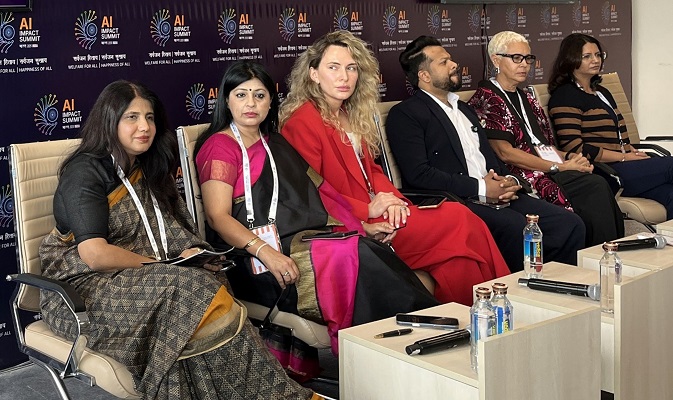
‘Gender Parity through innovation and entrepreneurship is a critical driver for democratization of AI’ emerged as a defining takeaway at a global panel convened by BRICS Chamber of Commerce & Industry Women Empowerment (BRICS CCI WE) during the India AI Impact Summit 2026 at Bharat Mandapam. The session, themed “From Implementers to Innovators: Shifting the Narrative Towards Women Entrepreneurship in AI,” placed women at the center of enterprise creation, ecosystem leadership and responsible AI governance.
The high-powered discussion brought together global leaders, entrepreneurs, investors and ecosystem builders to deliberate on how artificial intelligence can truly be democratized — not merely through access, but through inclusive ownership and women-led innovation. The consensus was clear: AI is no longer a frontier technology; it is rapidly becoming core infrastructure. Ensuring gender parity in its development is not just a social imperative, but an economic and technological necessity.
Welcoming the gathering, Mr. Sameep Shastri, Vice Chairman, BRICS Chamber of Commerce & Industry, underlined India’s expanding global influence in the AI ecosystem and the importance of inclusive growth. He noted that as India assumes the BRICS Presidency in 2026, it aims to strengthen cooperation in digital innovation, entrepreneurship and responsible AI development. Emphasizing that AI must be both powerful and inclusive, he positioned India as a key advocate for equitable technology frameworks within BRICS and beyond.
Setting the tone for the session, Ms. Ruby Sinha, President, BRICS CCI WE and Founder of Sheatwork, reframed the current AI moment. She observed that AI has moved beyond being a buzzword or emerging trend — it is now embedded in the architecture of governance, business and social systems. India’s AI journey, she noted, is drawing global attention for its scale and impact, particularly in digital public infrastructure. Echoing the vision articulated by Prime Minister Narendra Modi, she emphasized that democratization of technology must include a pointed focus on gender parity. “For decades, women were asking for access. Today, we are moving from asking for a seat at the table to designing the table itself,” she remarked, highlighting the shift from participation to leadership.
Ms. Amrita Chowdhury, Co-Founder and CEO of Gaia, reinforced this narrative by pointing to the steady rise of women-led ventures in technology. While women lead nearly 20 percent of startups and MSMEs, their influence is growing across sectors such as FinTech, retail, supply chains and urban infrastructure. She stressed that innovation must reflect lived realities, and that embedding gender-responsive data into AI systems can help design safer mobility systems, smarter cities and inclusive service delivery. Her remarks underscored the importance of diversity in datasets and leadership to mitigate bias and ensure AI solutions address real-world challenges.
Adding an international regulatory perspective, Ms. Elvira Chache, Executive Director for AI Regulation and International Cooperation at Sberbank, highlighted the need for women’s presence not just in entrepreneurship but also in policymaking. She called for stronger collaboration among Global South nations to create shared communities of women innovators, enabling resource-sharing, including access to data. She observed that institutions are increasingly offering grants and seed capital to women-led AI ventures, signaling a positive shift toward structured support for scaling impact.
From the startup ecosystem standpoint, Mr. Bibin Babu, Founder of GrowQr AI and Co-Founder of Paycio, pointed to the distinctive strengths he has observed in women-led AI startups. According to him, many women founders prioritize durability, clarity of purpose and early validation of their solutions. Rather than chasing high valuations, they focus on sustainable revenue models and responsible innovation. In emerging domains like agentic AI, where context and accountability are paramount, he noted that long-term thinking and problem-oriented design are critical. His message to aspiring women founders was unequivocal: leadership in AI does not require permission — it requires conviction and action.
Offering insights from Latin America and the broader Global South, Ms. Nagila Guimaraes, Director of Global Strategic Partnerships at Instituto +Mulheres and Founder and Co-curator of AI Rio 2026, emphasized cross-border collaboration. She argued that democratizing AI means ensuring women are not only trained to use AI tools but are empowered to build companies, influence regulatory frameworks and lead international collaborations. Across BRICS nations, she observed growing momentum among women founders. The next step, she suggested, lies in structured mentorship networks, shared research platforms and improved access to global funding pipelines.
At the grassroots level, Ms. Shivani Singh Kapoor, Co-Founder of ThinkStartup, presented encouraging data from youth innovation programs across India. Over the past five years, girls’ participation in pan-India innovation competitions has reached 45 percent, generating AI-driven solutions ranging from elderly care wearables to drone-based bio-decomposers. She stressed the need for sustained school and college-level interventions, structured market pathways and vertical challenges to convert these young innovators into tomorrow’s AI entrepreneurs capable of competing globally.
In her concluding remarks, Ms. Ruby Sinha reiterated that the transition underway is from participation to leadership. Women must be recognized not merely as adopters of AI technologies but as architects of AI ecosystems. Inclusive innovation, she emphasized, is fundamental to ensuring AI development aligns with democratic values and equitable growth.
The discussion, attended by delegates including Ankita Sachdev, Joint Director, BRICS CCI, reinforced a pivotal shift in the global AI discourse. AI is no longer experimental or speculative. It is infrastructure shaping economies, governance and everyday life. The defining question is not whether AI will transform societies, but who will shape its design, deployment and governance.
About BRICS CCI WE: The BRICS Chamber of Commerce & Industry, established in 2012, is a not-for-profit, non-governmental organization registered under the Societies Registration Act, 1860, Government of India. Empanelled with NITI Aayog and recognized by the United Nations, the Chamber works to promote commerce and industry among BRICS nations and other friendly countries through trade fairs, seminars and institutional partnerships. Its Women Empowerment Vertical, BRICS CCI WE, is dedicated to creating an enabling ecosystem for women entrepreneurs and professionals across geographies, advancing gender-inclusive economic growth in the age of AI.