



Summary:Black holes at the heart of galaxies could swell to 50 billion times the mass of the sun before losing the discs of gas they rely on to sustain themselves, according to research.
Black holes at the heart of galaxies could swell to 50 billion times the mass of the sun before losing the discs of gas they rely on to sustain themselves, according to research at the University of Leicester.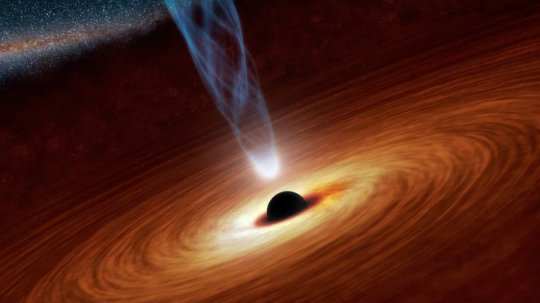
In a study titled ‘How Big Can a Black Hole Grow?’, Professor Andrew King from the University of Leicester’s Department of Physics and Astronomy explores supermassive black holes at the centre of galaxies, around which are regions of space where gas settles into an orbiting disc.
This gas can lose energy and fall inwards, feeding the black hole. But these discs are known to be unstable and prone to crumbling into stars.
Professor King calculated how big a black hole would have to be for its outer edge to keep a disc from forming, coming up with the figure of 50 billion solar masses.
The study suggests that without a disc, the black hole would stop growing, meaning 50 billion suns would roughly be the upper limit. The only way it could get larger is if a star happened to fall straight in or another black hole merged with it.
Professor King said: “The significance of this discovery is that astronomers have found black holes of almost the maximum mass, by observing the huge amount of radiation given off by the gas disc as it falls in. The mass limit means that this procedure should not turn up any masses much bigger than those we know, because there would not be a luminous disc.
“Bigger black hole masses are in principle possible — for example, a hole near the maximum mass could merge with another black hole, and the result would be bigger still. But no light would be produced in this merger, and the bigger merged black hole could not have a disc of gas that would make light.
“One might nevertheless detect it in other ways, for example as it bent light rays passing very close to it (gravitational lensing) or perhaps in future from the gravitational waves that Einstein’s General Theory of Relativity predicts would be emitted as it merged.”
Source:University of Leicester(http://www.sciencedaily.com/releases/2015/12/151218085632.htm)