


Summary:The Arctic Ocean will take up more carbon dioxide over the 21st century than predicted by most climate models, according to researchers. This additional carbon dioxide causes a distinctly stronger ocean acidification.
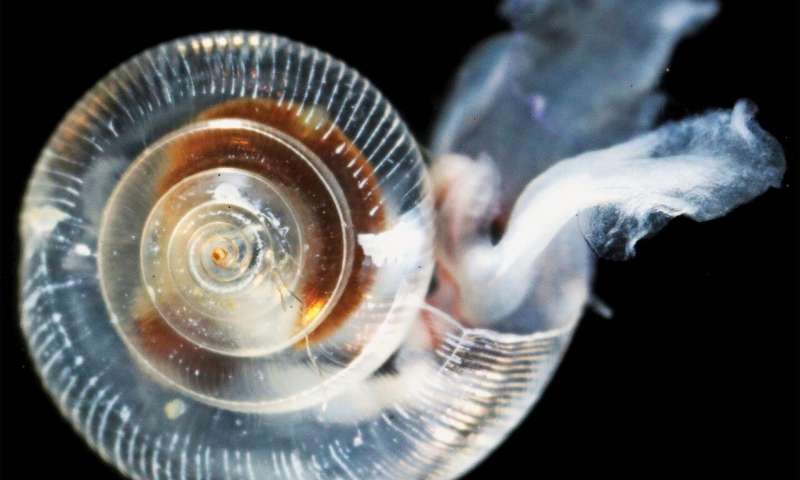
The Arctic Ocean will take up more CO2 over the 21st century than predicted by most climate models. This additional CO2 causes a distinctly stronger ocean acidification. These results were published in a study by climate scientists from the University of Bern and École normale supérieure in Paris. Ocean acidification threatens the life of calcifying organisms — such as mussels and “sea butterflies” — and can have serious consequences for the entire food chain.
The ocean takes up large amounts of human-made CO2 from the atmosphere. This additional CO2 causes ocean acidification, a process that can already be observed today. Ocean acidification particularly impacts organisms that form calcium carbonate skeletons and shells, such as molluscs, sea urchins, starfish and corals. The Arctic Ocean is where acidification is expected to be greatest.
A study that was recently published in the scientific journal Nature by Jens Terhaar from Bern and Lester Kwiatkowski and Laurent Bopp from the École normale supérieure in Paris shows, that ocean acidification in the Arctic Ocean is likely to be even worse than previously thought. The results show that the smallest of the seven seas will take up 20% more CO2 over the 21st century than previously expected, under the assumption that the atmospheric CO2 concentrations continue to increase. “This leads to substantially enhanced ocean acidification, particularly between 200 and 1000 meters,” explains Jens Terhaar, member of the group for ocean modeling at the Oeschger-Centre for Climate Change Research at the University of Bern. This depth range is an important refuge area for many marine organisms.
Consequences for the food chain
Ocean acidification negatively impacts organisms that build calcium carbonate skeletons and shells. In sufficiently acidic waters, these shells become unstable and begin to dissolve. “Our results suggest that it will be more difficult for Arctic organisms to adapt to ocean acidification than previously expected,” says co-author Lester Kwiatkowski. A loss of these organisms is likely to impact the entire Arctic food chain up to fish and marine mammals.
New method improves projections
The international research team exploited the large divergence in simulated Arctic Ocean carbon uptake by current climate models. The researchers found a physical relationship across the models between the simulation of present-day Arctic sea surface densities and associated deep-water formation, with greater deep-water formation causing enhanced transport of carbon into the ocean interior and therefore enhanced acidification. Using measurements of Arctic sea surface density the research team was able to correct for biases in the models and reduce the uncertainty associated with projections of future Arctic Ocean acidification.
More:Science Daily