


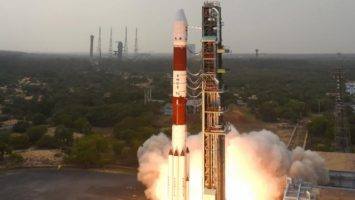
In its thirty eighth flight (PSLV-C36), ISRO’s Polar Satellite Launch Vehicle successfully launched the 1,235 kg RESOURCESAT-2A Satellite today morning (December 07, 2016) from the Satish Dhawan Space Centre SHAR, Sriharikota. This is the thirty seventh consecutively successful mission of PSLV.
After PSLV-C36 lift-off at 10:25 am IST from the First Launch Pad with the ignition of the first stage, the subsequent important flight events, namely, strap-on ignitions and separations, first stage separation, second stage ignition, payload fairing separation, second stage separation, third stage ignition and separation, fourth stage ignition and cut-off, took place as planned. After a flight of 17 minutes 05 seconds, the vehicle achieved a polar Sun Synchronous Orbit of 824 km height inclined at an angle of 98.725 degree to the equator (very close to the intended orbit) and 47 seconds later, RESOURCESAT-2A was separated from the PSLV fourth stage.
After separation, the two solar arrays of RESOURCESAT-2A deployed automatically and ISRO’s Telemetry, Tracking and Command Network (ISTRAC) at Bangalore took over the control of the satellite. In the coming days, the satellite will be brought to its final operational configuration following which it will begin to provide imagery from its three cameras. The data sent by RESOURCESAT-2A will be useful for agricultural applications like crop area and crop production estimation, drought monitoring, soil mapping, cropping system analysis and farm advisories generation.
Like its predecessors RESOURCESAT-1 and 2, RESOURCESAT-2A has a unique 3-Tier imaging system with Advanced Wide Field Sensor (AWiFS), Linear Imaging Self Scanner-3 (LISS-3) and Linear Imaging Self Scanner-4 (LISS-4) cameras. The AWiFS provides images with a sampling of 56 metres, a swath of 740 km and a revisit of 5 days whereas the LISS-3 provides 23.5 metre sampled images with 141 km swath and a repitivity of 24 days. LISS-4 provides 5.8 metre sampled images with 70 km swath and a revisit of 5 days.
With today’s launch, the PSLV has yet again demonstrated its reliability. The total number of satellites launched by India’s workhorse launch vehicle PSLV including today’s RESOURCESAT-2A has now reached 122, of which 43 are Indian and the remaining 79 are from abroad.